
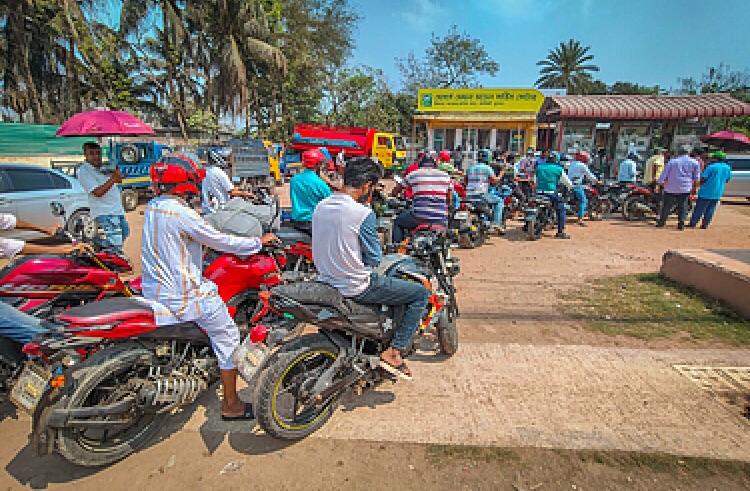
Global fuel supply disruptions caused by tensions in the Middle East have raised concerns about fuel availability in the country as well. In response to the uncertainty, people began buying fuel at nearly double the normal rate out of panic.
To curb this trend, the government imposed limits on fuel purchases and reduced supply to filling stations. Since then, long queues have formed at filling stations, with operators demanding increased supply. In this situation, the government has decided to lift the restrictions on fuel purchases.
The decision was taken at an emergency meeting held on Saturday evening by the Ministry of Power, Energy and Mineral Resources (Bangladesh). An official announcement is expected on Sunday morning.
Sources in the energy division said the government had adopted a cautious approach despite having reserves in stock. However, filling station owners and transport operators have been pressing for increased fuel supply. To prevent public suffering during the Eid-ul-Fitr travel rush, the government decided to remove the sales limit.
Energy adviser Iqbal Hasan Mahmud confirmed the decision to Prothom Alo over the phone. He said the fuel crisis is global and countries are discussing ways to address it. The government is working to increase fuel supply from multiple sources.
“The rationing was introduced as a precautionary measure. From Sunday, there will be no rationing or limit on fuel supply,” he said.
The adviser is currently in Tokyo, Japan, attending a two-day ministerial conference on Indo-Pacific energy security from 14 to 15 March. The ongoing global fuel crisis is also being discussed at the conference, which is expected to issue a joint declaration on its final day.
Earlier, to prevent abnormal sales, the government imposed limits on fuel supply starting 6 March. On 10 March, the limit was slightly increased for ride-sharing motorcycles. Initially set at two litres, the cap was later raised to a maximum of five litres.
In addition, from 7 March filling stations were supplied with 25 per cent less fuel than demand. From 11 March, supply to filling stations in divisional cities was increased by 10 per cent. Later, filling station owners demanded supply according to demand through a press conference. In Khulna, they even suspended fuel lifting from the depot on Saturday.
Sources at Bangladesh Petroleum Corporation (BPC), the state agency responsible for fuel imports, said a total of 18 fuel tankers are expected to arrive this month. By 14 March, six ships had already arrived. Another six vessels are scheduled to arrive by 27 March, while the arrival dates of the remaining six are yet to be confirmed.
Each tanker typically carries between 25,000 and 30,000 tonnes of fuel, mostly diesel. Only the last two ships are expected to carry jet fuel along with diesel. A ship carrying furnace oil is also scheduled to arrive on 17 or 18 March. In addition, efforts are underway to purchase a shipload of octane from the open market.
Petrol, octane and diesel are the fuels sold at filling stations. Petrol is entirely produced domestically, while about 50 per cent of octane is produced in the country and the rest is imported. The main concern, therefore, is diesel, which accounts for nearly 65 per cent of the fuel supplied by BPC annually.

No comments:
Post a Comment
Thank you for your response